The short answer
Westchester County requires home improvement contractors to hold a county license, issued by the Department of Consumer Protection. To check one, open the county’s Find a Licensed Contractor search, choose Company Name, type part of the business name, and press Submit. A licensed contractor comes back with their company name, the license holder’s name, and the date the license expires. No result, or an expired date, means you should stop and ask questions. You can also check by phone at (914) 995-2155.
Most renovation horror stories start the same way: a friendly estimate, a big deposit, and no paperwork worth the name. In Westchester County you have a real advantage over homeowners in a lot of other places, because the county licenses home improvement contractors and publishes the list of licensed contractors in Westchester. The lookup is free and takes about a minute.
The license is only the first check, though. Below is the full lookup, step by step with screenshots, followed by the nine other checks we’d run before hiring anyone to work on our own house. That includes us.
Why Westchester County licenses contractors
Under Westchester County law, anyone in the home improvement business in the county needs a county license. That includes general contractors who organize other trades. The law covers repairs, remodeling, and installations in houses, condos, co-ops, and apartments of up to three units, and it names kitchens, bathrooms, and tile work specifically. There’s no minimum job size.
The license means something. Applicants have to show liability insurance and workers’ compensation and disability coverage, and they go through a background investigation. The county can deny a license for unpaid judgments or “an unacceptable amount of home improvement complaints.” Licenses run for two years, so a contractor who was licensed when your neighbor hired them may not be licensed today. Working without one is a Class A misdemeanor.
How to look up a contractor’s license, step by step
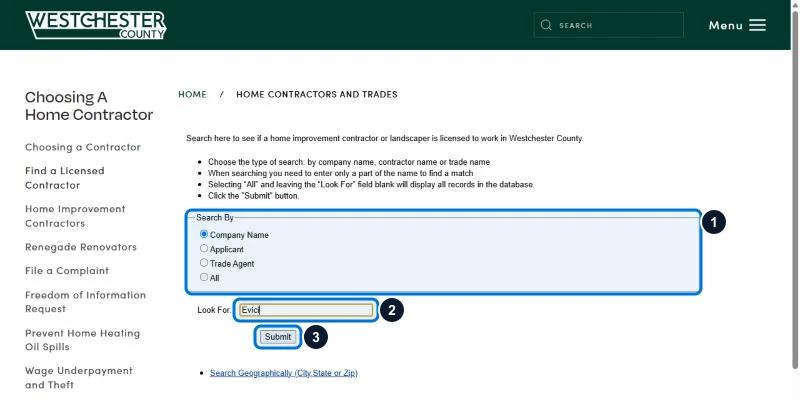
The search lives on the Department of Consumer Protection’s website. Here’s the whole thing, using our own company as the example.
- Open the county’s license search. Go to consumer.westchestercountyny.gov → Find a Licensed Contractor. The search form loads in the middle of the page.
- Choose what to search by. Company Name is the default and usually the best place to start. Use Applicant if you only know the owner’s name, or Trade Agent for a trade name.
- Type part of the name. The search matches partial names, so “Evici” finds “Evici Corp.” Fewer letters is safer than a misspelling.
- Press Submit and read the result.
What a licensed result looks like
A match returns a short table with the company name, the license holder’s name, the license expiration date, and a phone number. Here’s ours, searched in October 2026:
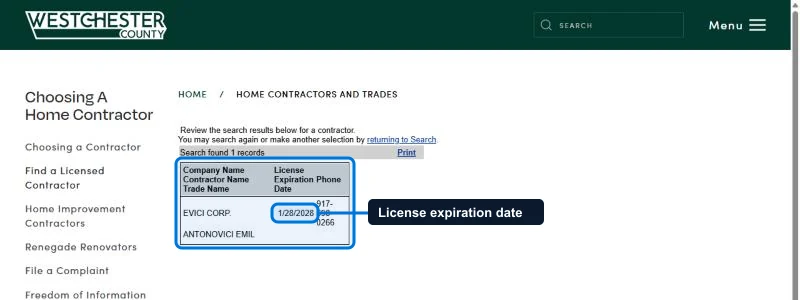
When you read the result, check three things:
- The expiration date is in the future, ideally past the end of your project. An expired license is the same as no license.
- The name matches your paperwork. The company on the estimate, the contract, and the license should be the same business. If the person quoting your job works under a different name, ask why.
- The phone number makes sense. It should connect you to the company you’re talking to, not a stranger.
What the lookup doesn’t show
The result has no license number, no license type, no insurance details, and no complaint history. That’s why the checks below matter. If a search comes back empty, try fewer letters, try the owner’s name under Applicant, or leave off “Inc.” and “LLC.” If you still find nothing, call the Department of Consumer Protection at (914) 995-2155 before you sign anything.
The 9 other checks before you hire
A valid license tells you a contractor cleared the county’s bar. These nine checks tell you whether they’re the right contractor for your job.
1. Find the license number on the estimate
County law requires licensed contractors to print their license number on their advertising, proposals, change orders, invoices, and contracts. New York’s contract law requires it too. So the number should already be on the estimate in your hand. If it isn’t there, ask for it, and be wary of a contractor who can’t give you one.
Licensed contractors’ vehicles also carry a county decal, and trucks at a job site have to show the company’s name and address. A plain unmarked van isn’t proof of anything on its own, but it’s one more thing that should line up.
2. Look up the plumber and the electrician separately
Plumbers and electricians aren’t covered by the home improvement license. The county licenses them separately and has its own search: Find a Licensed Plumber or Electrician. There are four trade license types: Master Electrician, Countywide Master Plumber, Restricted Master Plumber (allowed to work only in certain municipalities), and the Journey Level Plumbing Certificate. A journey-level plumber can work for a master plumber but can’t contract for plumbing work on their own.
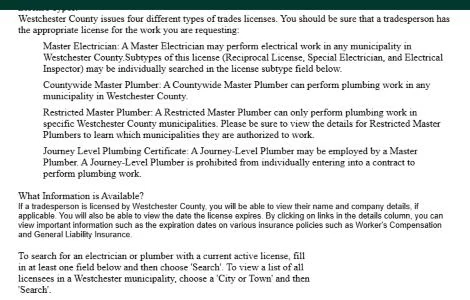
Kitchen and bathroom remodels almost always involve both trades, so ask your general contractor who will do the plumbing and electrical work, and look those people up too. The trade search is more detailed than the home improvement one. You can filter by town and license type, and the detail links show the expiration dates on the tradesperson’s workers’ compensation and general liability policies.
3. Search the “Renegade Renovators” list
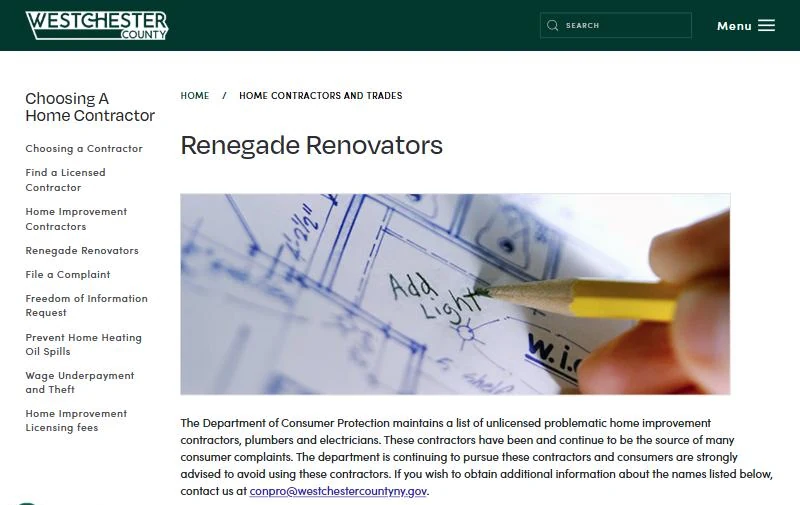
The Department of Consumer Protection keeps a public list of unlicensed contractors, plumbers, and electricians it calls Renegade Renovators. In the county’s words, these contractors “have been and continue to be the source of many consumer complaints.” Use your browser’s find function (Ctrl+F, or Cmd+F on a Mac) to search the page for both the company name and the owner’s name. Many entries list several business names for the same person.
4. Ask the county about complaint history
The online lookup won’t tell you how a contractor handles problems, but the county will. Call the Department of Consumer Protection at (914) 995-2155 and ask about complaints. The county also suggests checking the Better Business Bureau. A long-running business with a complaint or two that got resolved is normal. A pattern is not.
5. Check for judgments, liens, and lawsuits
A contractor who isn’t paying their subcontractors or suppliers can stall your job, and under New York’s Lien Law an unpaid sub or supplier may be able to file a mechanic’s lien against your property. These records are public and free to search:
| Where to look | What it’s good for |
|---|---|
| Westchester Records Online (County Clerk) | Money judgments and mechanic’s liens filed in the county, searchable by last name or business name |
| WebCivil Supreme (NY Courts) | Lawsuits in State Supreme Court. Search by party name, and switch from open cases to all cases |
| WebCivil Local (NY Courts) | Cases in city courts, including small claims |
One lawsuit in a long career doesn’t mean much on its own. Look for repeats: several homeowners, or several suppliers, saying the same thing.
6. Get the insurance certificates, and verify them
Don’t take “we’re insured” at face value. Ask for certificates sent by the contractor’s insurance agent, with you named as the certificate holder:
- General liability insurance, for damage to your home or injury to someone who isn’t a worker
- New York workers’ compensation, usually a form C-105.2 or U-26.3
- New York disability and paid family leave coverage, usually a form DB-120.1
- A CE-200 exemption instead of the two above, if the business really has no employees
- Current policy dates, covering the whole length of your project
- The right business name, the same one that’s on the license and the contract
You can check workers’ compensation yourself with the state’s free Does Employer Have Coverage? search, run by the Workers’ Compensation Board. Search by the business name and it shows the carrier and the policy dates. This matters more than most homeowners realize: if an uninsured worker is hurt on your property, you don’t want to find out who’s responsible for their injury the hard way.
7. Confirm it’s a real registered business
Corporations and LLCs are registered with New York State. Look the company up in the Department of State’s free Corporation and Business Entity Database. It shows when the business was formed and whether it’s active. It doesn’t list owners, but a company that was formed last month and is quoting your whole kitchen is worth a follow-up question.
8. Get a written contract with everything the law requires
New York law requires a written contract, signed by everyone, for any home improvement job over $500, and the county advises getting one on every job. Avoid any contractor who says a written contract isn’t needed. Under the state’s General Business Law, the contract has to include:
| Required item | What to look for |
|---|---|
| Contractor’s name, address, phone, and license number | A real business address, not only a P.O. box or a cell number |
| Approximate start and completion dates | Including anything that could change the completion date |
| A specific description of the work and materials | Make, model number, or other identifying details, plus the price |
| A progress payment schedule | Dollar amounts tied to stages of the work, not to the calendar |
| What happens to your payments | Money paid before completion goes into an escrow account at a New York bank within five business days, or is covered by a bond or letter of credit |
| A mechanic’s lien notice | Explaining that unpaid contractors or suppliers may have a claim against your property |
| Your three-day right to cancel | You can cancel in writing until midnight of the third business day after signing |
| Insurance disclosure | The property or casualty policy that covers the work, with the insurer’s contact information |
On top of the legal minimum, the county suggests putting these in writing: guarantees on workmanship and materials, who obtains and pays for any permits the job needs, how often debris gets hauled away, and a lien waiver clause, so you can hold back the final payment until subcontractors and suppliers have been paid.
Keep the deposit small
The county advises avoiding contractors who want cash, or who want more than one-third of the price before work begins. Pay by check or credit card, not cash, and tie each payment after that to work you can see is done. Be skeptical of “I need the money up front for materials.” The county notes that reputable contractors can buy materials on credit.
9. Find out who will actually be on your job
This is the question homeowners most often forget, and it says a lot about how the job will run. The county’s own checklist asks it directly: will the contractor personally be on site while the work is done? All of the time? Some of the time? County law also requires licensed contractors to directly supervise the employees and subcontractors on their jobs.
At a lot of companies, the person who sells you the job never comes back. A project manager splits their time across a dozen sites, and the crew changes from week to week. That isn’t automatically bad, but you should know which model you’re buying. Ask:
- Who will be on site day to day, and who makes the call when something unexpected turns up behind a wall?
- Will your own employees do the work, or will it be subcontracted? To whom?
- How many other jobs will you be running at the same time?
- Can I call a reference whose job is still in progress, not just one that finished well?
Red flags worth walking away from
Most of these come straight from the county’s guidance on choosing a contractor:
- No county license, or a license that has expired
- No license number on the estimate or contract
- Showing up at your door unannounced, or selling by phone
- High-pressure pitches, deals that are only good today, or references you can’t reach
- “We don’t need a written contract”
- Only a P.O. box and a cell phone, with no business address you can verify
- Wanting cash, or more than a third of the price before work starts
- Asking you to get the permits. The county says that “could mean that the contractor is not licensed and does not want to contact the local building authorities.”
- Offering a discount for using your home as a “model” or for sending referrals
A very low bid is worth a second look too. The county points out that it may mean the contractor made a mistake, or left out work the other bidders included. Get at least three estimates written against the same scope, so you’re comparing the same job.
Once you’ve hired someone
Your due diligence doesn’t stop at the signature. Keep a job file with the contract, plans, change orders, invoices, canceled checks, lien releases, and photos of the work in progress. Don’t sign a certificate of completion until the work matches the contract. If something goes wrong and you can’t resolve it, the Department of Consumer Protection takes complaints and will try to mediate, at no cost to you. You can also file with the New York Attorney General.
How we’d want to be checked
We’d rather be vetted than taken on trust. Evici Corp is licensed by Westchester County as a home improvement contractor, and you can confirm it in the county search above. We’re insured, and we give every client a written estimate and contract. Because Evici is owner-supervised, the person who walks your space at the estimate, Emil, is the person who runs your job.
If you’re comparing contractors for a kitchen, bathroom, or whole-home project anywhere in Westchester County, run every one of these checks on us too. Then request a free estimate and ask us anything on this list. You can also read more about how we work.
Sources: Westchester County Department of Consumer Protection, Choosing a Home Improvement Contractor, Home Improvement Contractors, Renegade Renovators, and Trade Licenses Search; Laws of Westchester County, Ch. 863, Art. XVI; New York General Business Law §770 and §771; New York Lien Law §71-a. All checked October 2026. This guide is general information, not legal advice.